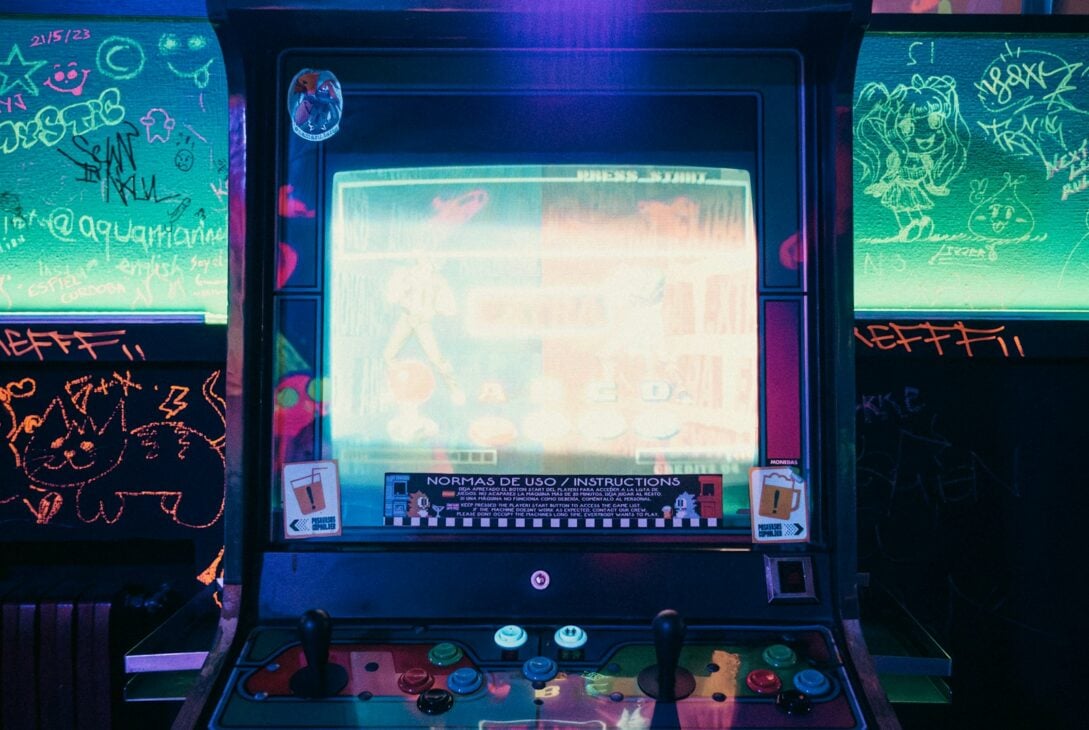
Long before games lived on phones and consoles, they lived in dark rooms filled with glowing cabinets, bleeping sounds and the clatter of coins. Arcades were where video games became a cultural force, and many ideas we take for granted in modern games, from high-score tables to local multiplayer, were born there.
This is a short history of arcade culture and what it left behind.
The Early Days: From Pinball to Pixels
Coin-operated amusements existed long before video games. Pinball machines, mechanical games and novelty machines filled amusement halls for decades. The leap to video came in the early 1970s. Computer Space, released in 1971, is generally credited as the first commercial coin-operated video game, though it was too complicated to become a hit.
The breakthrough was Pong, released by Atari in 1972. Its idea was simple: two paddles, one ball, instantly understandable. Players could walk up, grasp the rules in seconds and start playing. That simplicity made it a success, and a new industry was born.
The Golden Age
The late 1970s and early 1980s are often called the golden age of arcade games. A few titles stand out:
- Space Invaders (1978): Taito’s shooter became a phenomenon in Japan and abroad, and helped establish video arcades as a common sight.
- Asteroids (1979): a vector-graphics classic where players could enter their initials on the high-score table.
- Pac-Man (1980): Namco’s maze game appealed to a very wide audience and became a pop-culture icon, with a non-violent design that attracted many players who didn’t enjoy shooters.
- Donkey Kong (1981): introduced the character later known as Mario, and helped establish the platformer genre.
- Galaga (1981) and many others added variety and colorful designs.
Arcades became social gathering places, especially for teenagers, who competed for the top spot on the leaderboard and showed off to friends.
How Arcade Design Shaped Games
Arcade games had one big goal: to make players want to play again. That shaped design in lasting ways.
- Easy to learn, hard to master. Controls were simple, but skill ceilings were high. Players could understand a game in seconds and keep improving for months.
- Short sessions. Games were built around brief rounds, which encouraged repeat play.
- Escalating difficulty. Levels grew harder, and a mistake could end your run, which created tension and excitement.
- Visible scores and leaderboards. Initials on a high-score screen turned play into a public competition.
- Attract modes. Cabinets showed demos and flashing visuals to draw players in from across the room.
Those principles still influence mobile games, roguelikes and competitive online games today.
The Fighting Game Revival
By the late 1980s, home consoles were improving and arcades faced competition. Then in 1991, Capcom released Street Fighter II, a game that revived arcades and created a new community. Players lined up to challenge each other face to face, and the competitive “fighting game scene” was born, with players learning combos, spacing and strategy. Many of today’s esports events trace roots back to arcade tournaments.
Other genres thrived in arcades too. Racing cabinets with seats and wheels, light-gun shooters, rhythm games such as Dance Dance Revolution and music-based machines offered experiences that early home consoles couldn’t match.
The Decline in the West
Through the 1990s and 2000s, home consoles caught up. The PlayStation and later systems brought arcade-quality graphics into living rooms, and online play replaced the need to gather in person. In many Western countries, arcades closed in large numbers. Rising rents, changing habits and the convenience of home gaming all played a part.
The industry also shifted from coins to other models. Arcades survived in some places by focusing on redemption games, family entertainment centers and entertainment venues that combined games with food, bowling or mini golf.
Where Arcades Survived and Revived
- Japan: game centers remained popular for decades, with multi-floor buildings featuring rhythm games, fighting games, crane machines and card-based games. They stayed an important part of urban culture.
- Retro arcades and arcade-cafés: in recent years, venues devoted to classic cabinets have appeared in many cities, often combining games with casual food and drink and a nostalgic atmosphere.
- Family entertainment centers: many combine arcade games with other activities for families and groups.
- Home arcade cabinets and mini consoles: enthusiasts and collectors keep classic machines alive, and re-released collections make old games available on modern devices.
What Arcades Left Behind
Local multiplayer and social play
Arcades taught designers that games are better with other people in the room. Today’s couch co-op titles and party games keep that spirit alive.
The competitive scene
High scores, rankings and head-to-head challenges laid the groundwork for esports, speedrunning and online leaderboards.
Pixel art and chiptune music
The visual and audio styles shaped by arcade hardware limitations now live on as a deliberate aesthetic in many modern indie games.
Design wisdom
Clear goals, immediate feedback, tight controls and a “one more try” feeling remain core principles of good game design.
Preservation culture
Collectors, museums and fans work to preserve arcade hardware and software, since these machines are fragile and increasingly rare.
A Word on Money and Chance
Some modern arcade machines blur the line between skill and chance, such as certain prize-based machines. If you take children to an arcade, set a clear budget beforehand and talk about how some games are harder to win than they look. The classic skill-based cabinets remain the heart of the experience.
How to Enjoy Arcade History Today
- Visit a retro arcade or a game museum near you and try a few classic cabinets.
- Play official collections of classic arcade games on modern consoles and PCs.
- Watch documentaries and talks about the golden age.
- Try a fighting game or rhythm game, which still carry arcade DNA.
- Join a local retro-gaming community or tournament.
Frequently Asked Questions
Which was the first arcade video game?
Computer Space (1971) is generally recognized as the first commercial arcade video game, while Pong (1972) was the first major hit.
Why did arcades decline?
A mix of better home consoles, online play, changing habits and rising costs. Arcades haven’t vanished, but they changed shape.
Are classic arcade games still fun?
Many are. Their simplicity and tight design hold up well, though some can feel punishing by modern standards.
Can I play arcade classics at home?
Yes, through official collections, re-released machines and compilations on modern platforms. Look for licensed versions.
Conclusion
Arcades taught the world that games could be social, competitive and endlessly replayable. Their glowing cabinets may be rarer now, but their lessons live in almost every game you play. Next time you see a classic machine, give it a try and see how long you can last.